
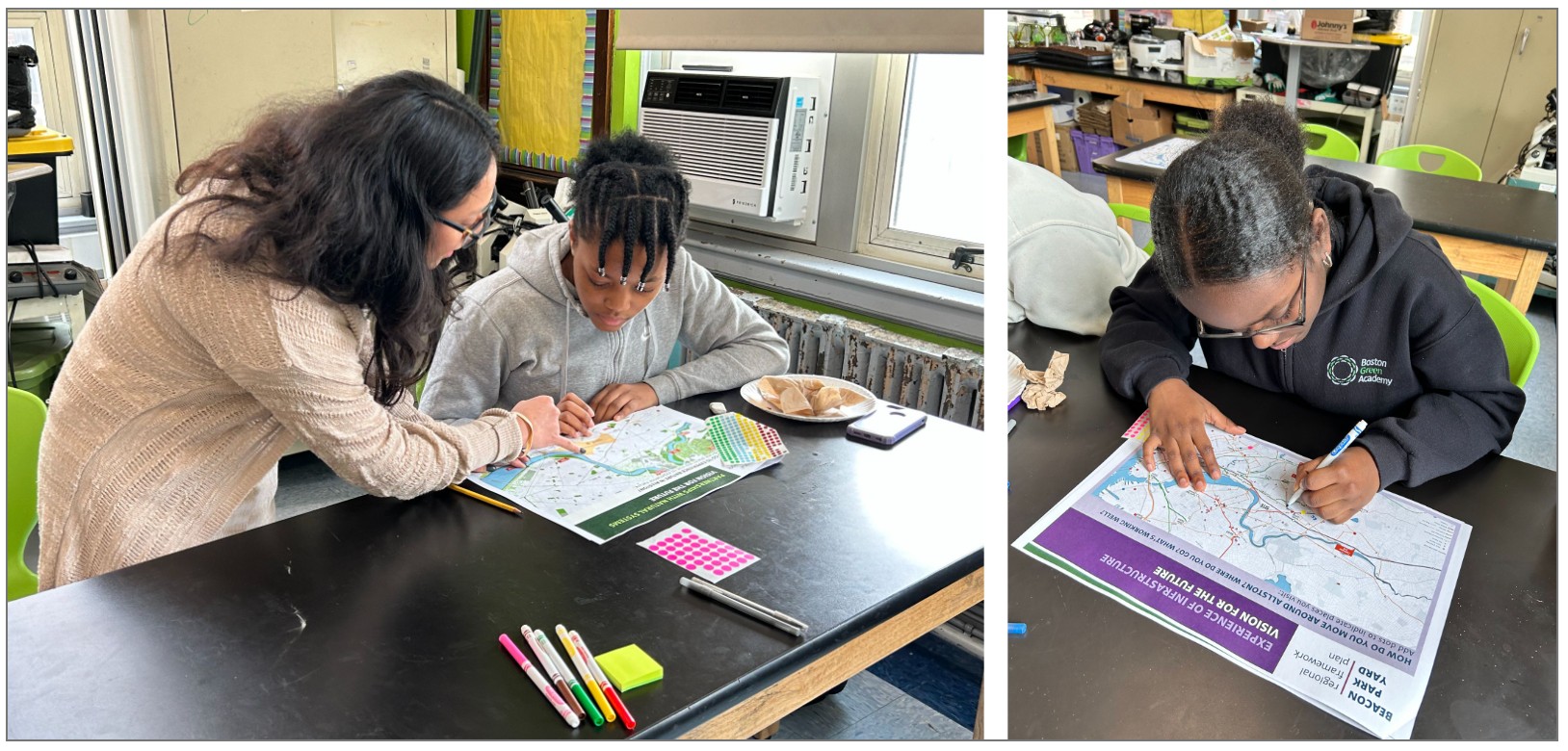
This toolkit has been created by educators from Common Ground High School, Boston Green Academy, The Greene School, and New Roots Charter School, with support from partners at MassCOSH and the Green Schools National Network. The toolkit is designed to be used in high schools, youth development organizations, and community planning/development efforts. It’s currently a prototype ready for testing and improvement – please share feedback with jtolman@nhep.com.
Phenomenon: Public Spaces are Not Created Equal
Public spaces – parks, plazas, libraries, recreation centers, and other shared community facilities – have long been essential to civic life, equity, and public well-being. Historically serving as grounds for trade, discourse, celebration, and protest, these spaces vary widely in accessibility, amenities, maintenance, funding, and safety. Green spaces, in particular, play a crucial role in promoting environmental and public health by offering recreation, mental health benefits, and relief from urban stressors. Research consistently shows that access to these spaces can reduce stress, lower chronic illness rates, and improve overall community outcomes. Yet even when such spaces exist, questions remain: Do people have access to them? And if so, do they use them? For what? Students can play a critical role in analyzing the parks in their communities, using their analysis to understand bigger patterns, and design and enact solutions that make parks available to all.
Immersion Experience: Let’s look at your community/neighborhood/town/city
This 4PBL experience launches with “Cold Read” of a public space: Visit a public space close to your school – or two, if there are two nearby. It could be a college campus, a community greenspace, a city park. This public space can even be your school grounds, if it is open to the public. Ask students to:
Observe: Write down who and what and who they see.
Evaluate: How many stars would you give this public space, 0 to 5? Defend your score.
Narrate: Write a less than 100 word story about the place: How it came to be, from the perspective of the park itself, from the perspective of a person who uses the park.
Design: What’s one change you’d make to this public space to better meet community needs?
Explore this phenomonen and immersion experience.
Place-based Investigation: Exploring Our Parkscape
In many communities, the availability of free indoor and outdoor public spaces might be limited and unevenly distributed. When equitably distributed, these public assets allow people of all ages, races, abilities, and socioeconomic backgrounds to gather, learn, and thrive together. Ensuring that every neighborhood, especially historically marginalized ones, has safe, accessible public spaces is a fundamental aspect of building resilient communities. The aim is for students to gain a comprehensive understanding of place by completing a narrative journey of public spaces through research (historical context of public spaces), reading nonfiction and fiction texts that highlight issues concerning public spaces.
Explore a set of field and text-based learning experiences that help students explore their place.
Project: The Story of Our Spaces
The goal of the projects outlined in this toolkit is for students to collaborate in small groups to conduct a deeper analysis of public spaces in their residential communities, school communities and the cities in which they live. Each group will focus on a specific public space(s) within their chosen community. Through the use of the Space Eco Audit tool (EcoRise, 2025) or the Environmental Assessment of Public Recreation Spaces Audit tool (EAPRS) or even the EAPRS Mini-Tool, students will evaluate their chosen public spaces, rate the spaces they have visited, conduct research and curate multiple sources of information based on their public space. The tool will be used in a 5 star rating system, which is familiar to most people (ie, YELP, product reviews). Students will also be tasked with conducting interviews with community members (demographic points) who interact with these spaces, and request interviewees to also complete the Space Eco Audit or EAPRS Audit tool and record (video/audio) interactions – ultimately, curating a narrative of the public space.
Problem-Solving: Working With Community To Design Better Public Spaces
Now that students have evaluated how effectively specific public spaces are meeting community needs, and gathered stories and experiences of community members who use that park, they are ready to define the problem: Parks in our community can better meet the needs of our community. Depending on the result of their assessments, they can focus in on specific challenges: Some community members have a difficult time accessing this public space. Some community members don’t feel safe. The park lacks a specific resource the community wants and needs – natural areas, health and fitness resources, trash and recycling. What is available needs to be better maintained and stewarded. The story of the data would help students/groups decide what to focus on. However, a teacher or community leader could preselect to help with what makes sense for the group or timeframe