TLDR:
- Invite your seniors to a high school faculty meeting – maybe on Earth Day.
- Hold a fishbowl conversation, where you ask them about how your school has supported their growth as environmental leaders – and how you could do better.
- Then, work in teams of students and staff to fill big sheets of butcher paper, one for each grade – creating a map of the specific ways your school engages students as environmental problem-solvers.
- Then, add what you could do better. Use a different color to make it stand out.
- Move around, so that people can contribute to multiple maps.
- Do a gallery walk. Assign an exit pass: What do you most want to do to strengthen the way your school helps every student grow into a powerful environmental leader?
- Post the map publicly. Keep the conversation and the work going.
See a slide deck and agenda, and a guide to leading fishbowls.
It’s April 22, 2026 – Earth Day. Common Ground High School’s staff – teachers, student supporters, school leaders – finish up their lunch and make their way to our cafeteria. It’s like most Wednesdays at Common Ground: school dismisses early once each week, to make room for our team to meet, work, and build our practice together.
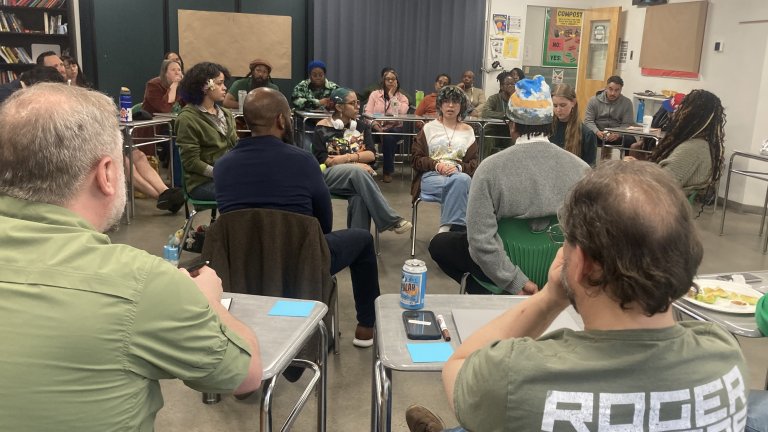
This week, though, the room looks and feels different. In half the space, chairs are arranged in two concentric circles. In the other, craft paper and markers are spread across four cafeteria tables, each set with space for ten.
More importantly, who is in the room is different than on a typical Wednesday. Most students have headed home for the day or joined after-school programs – but six seniors stay behind to join what’s normally an adult-dominated space.
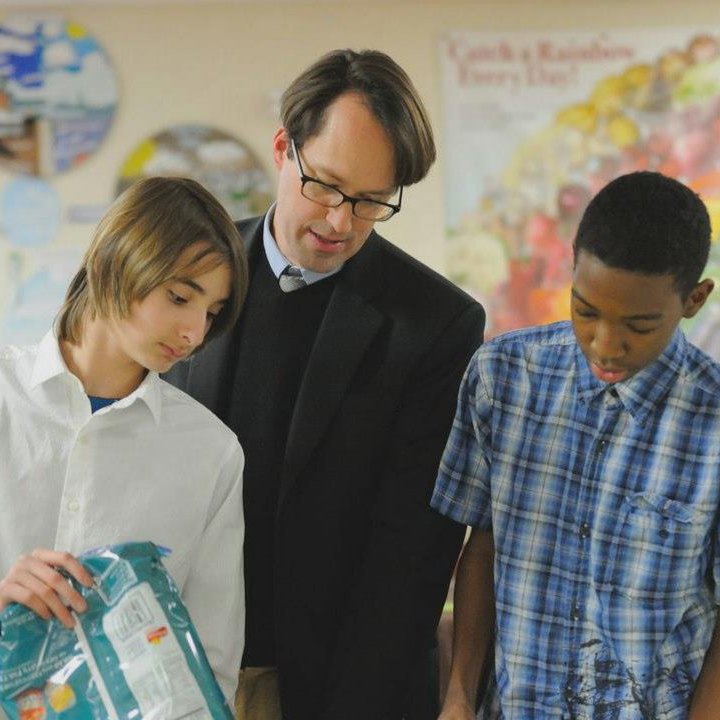
There are guests, as well: Jacob Jackson, a Baltimore-based filmmaker and conservationist. Dr. Thomas Easley, who has more titles than we can keep track of: forester, professor, hip hop artist, facilitator. Jacob has brought his camera to the circle – as Common Ground’s 2026 Environmental Leader in Residence; working to create short films about some of the leaders in this year’s senior class. Dr. Easley, who was our Environmental Leader in Residence in 2021 – but who never got to come to campus, since we were deep in the pandemic at the time – is here to help us hold the space and listen to our young people’s experiences.
Listen First: Students At The Center
The conversation starts with two simple questions:
Where have you seen young people step into their power as environmental leaders?
Where have you seen CG staff and others support young people’s growth as environmental leaders?
Everyone writes answers on post-it notes, and everyone has something to share – so we just popcorn out a few responses, and then make way for the real experts to speak.
Our seniors make their way, some confidently and some hesitantly, to the inner circle of chairs. Dr. Easley sets the stage:
Staff are here to listen. Take notes on what sticks with you, and what comes up for you as you hear young people hear their experience.
Students are here to share: You are here because we need your experience and leadership. Over time, our leadership changes. We want to know how you understand your experience.
Just as we are about to start, everything almost goes off the rails: A staff member raises his hand, and asks, “where are all the young men?”
There might be something useful in this question, but the timing and delivery are pretty awful. We acknowledge that gender matters in work to support student leadership. We remind the teacher, and ourselves, that students define their gender in lots of different ways (there are, in fact, young men in the circle). We thank the students who show up, and turn back to the real work: listening to them.
They have a lot to say: About exploring the farm as 9th graders. The climate change exhibition they created in their 10th grade year. Green Jobs Corps placements where they could put their learning into action. Community service day projects where they worked with little kids to rebuild school gardens. After-school programs where they explored nature. Summer programs that Common Ground staff helped them find. College-level courses on government, environmental science, and sustainable design Using the UN Sustainable Development Goals to choose a senior project.
Fifteen minutes in, Dr. Easley helps shift the conversation from what’s going well to a harder question:
What do you WISH had happened to support your leadership?
What can we do to enhance the opportunities that exist to support EVERY students’ growth as an environmental leader?
Students’ responses focus on traditional “environmental” issues – and on other things that matter just as much to them. Students talk about feeling shut down and powerless when teachers hear hateful language in their classrooms and don’t intervene.
By the time another 15 minutes pass, staff have filled dozens of post-it notes with what they heard students share and want to take away with them. We all need some time to process, so we take 5 minutes to take a break and move our bodies.
Creating A Map: A Four-Year Progression of Environmental Problem-Solving
When we’re back together, we shift to the other part of the cafeteria, with markers and long sheets of craft paper on cafeteria tables. We bring our post-it notes from the fishbowl with us, and add them to the maps. The team that designed this session spreads out among the tables, so we can listen and guide.
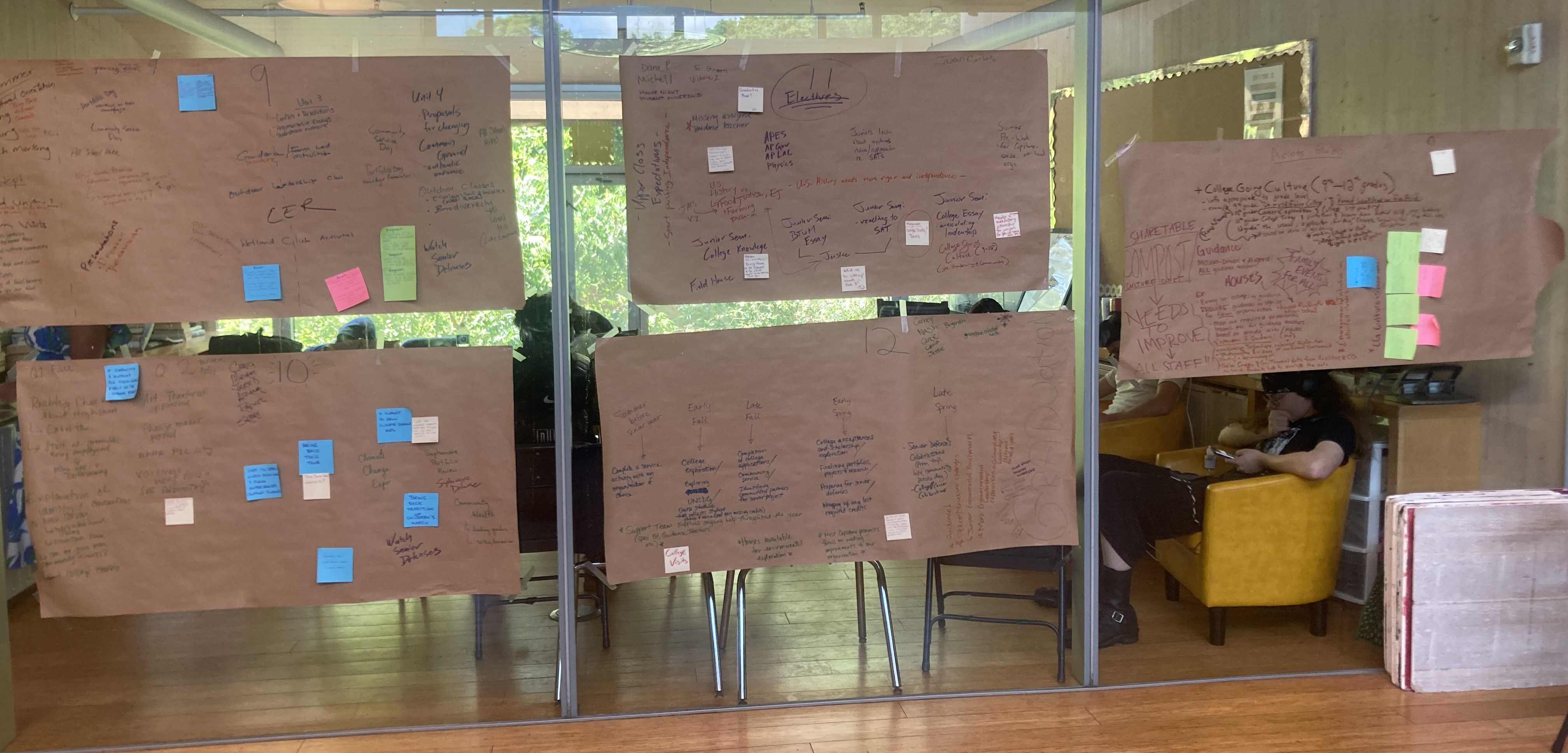
Each sheet of paper starts with just a grade at the top – 9, 10, 11, 12 – but soon they’re full of green and blue notes, mapping what happens from the start to the end of each grade level.
After ten minutes, the marker color changes: orange and red are used to reflect what we can create that will strengthen this four-year progression.
Because we’re a small school, no one works with just one grade – so we encourage people to get up and move to another table, cosign what they see there with stars and exclamation marks, and then add in our own contributions to students’ growth.
Some of our staff aren’t satisfied with just four grade level posters, and they create one of their own – focused on the whole-school structures and experiences we have and need. And some contributions – like those in the student fishbowl – definitely don’t stay focused on clean air, water and land. Teachers want to talk about college exploration and college prep as well. That’s o.k. – and we keep nudging the conversation back to Earth Day and environmental leadership.
What Comes Next?
Two hours is certainly not enough time to create the well-built, accessible, varied pathways that will help every student grow into an effective, powerful environmental problem-solver. It’s not even time to map what already exists, much less fill the gaps.
But it’s a start – and we need to keep the work moving. And so, we end by asking each staff member to name one thing they want to work on to keep building these pathways. That’s their exit pass, which we collect and look over as a facilitation team right after the workshop ends. If we were really on top of things, we’d hand these post-its back to their authors the next day – and check in again in a week, or a month, to celebrate the progress made.
And we make the work public: We post the maps we make on a big wall in a central space, so we have to walk by them and remember this core work every day. We take them down when we’re cleaning up for graduation.
It’s just one step – we need to do lots more – but hopefully it’s a step that’s helping us move in one direction as a community.
How Is Your School Supporting Young People’s Journey As Environmental Leaders?
We tell this story in hopes that other schools will join us.
What would you hear if you invited students in to share the experiences that have supported their growth as environmental problem-solvers? What gaps and opportunities would they help to uncover?
What maps would your staff and students create, if they worked together to chart the ways your school helps students grow their power and impact over four years?
Why make guesses or work on assumptions, when you can just ask?
We want to set you up for success. We know it is hard to carve out time for professional learning focused on the environment, or really listen to students, or zoom out to look at your whole school model. At Common Ground, Earth Day 2026 was the first time all school year we held an entire faculty meeting sacred for work on our environmental mission. And so, we want to give you the tools and the push you need.
Copy our slide deck and make it your own.
Use our agenda, and just change out the names of who’s doing what – or change lots more to make it better and tailored to your community.
Use this guide to leading fishbowls to help build the conversation.
Let us know how it goes. We’d love to learn from your school community.